Minimally Invasive Cardiac Surgery (MICS) in Ahmedabad — Dr. Abhishek R. Parmar
Modern heart surgery no longer always means a long scar down the chest and weeks of recovery. Minimally invasive cardiac surgery (MICS) in Ahmedabad allows complex heart procedures — including bypass, valve repair and correction of structural defects — to be performed through small 3–4 inch incisions between the ribs, without splitting the breastbone. Dr. Abhishek R. Parmar, a senior cardiothoracic and vascular surgeon with 20+ years of experience and 11,000+ surgeries, was an early adopter of these techniques in Gujarat and offers them to carefully selected patients at HCG Hospitals, Ahmedabad.
What is Minimally Invasive Cardiac Surgery?
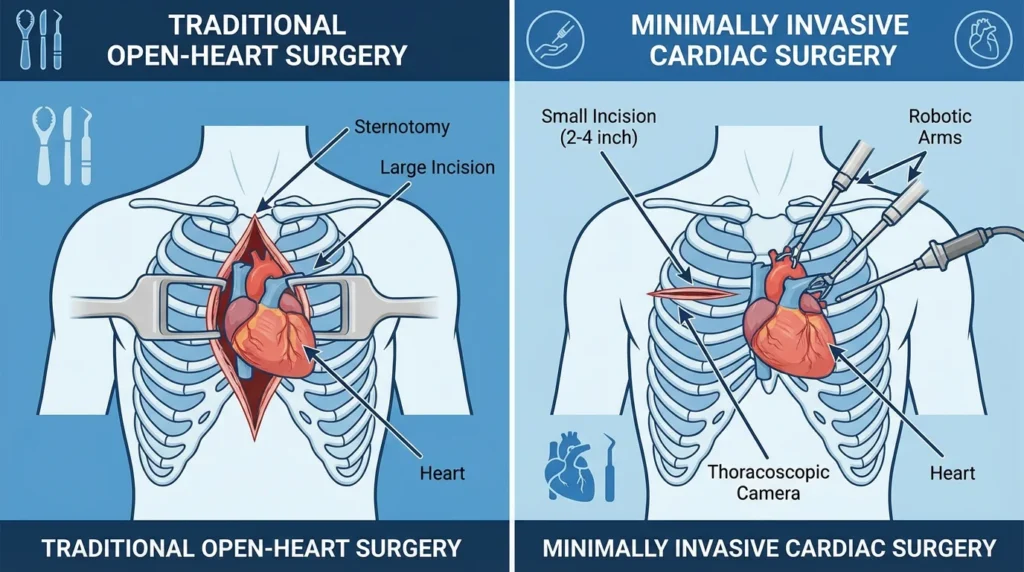
Minimally invasive cardiac surgery (also called keyhole heart surgery) is a group of techniques that allow the surgeon to operate on the heart through small incisions rather than a full sternotomy (cutting the breastbone).
Instead of opening the chest completely, the surgeon works between the ribs through a 3–4 inch incision, often using specialised long instruments and enhanced visualisation.
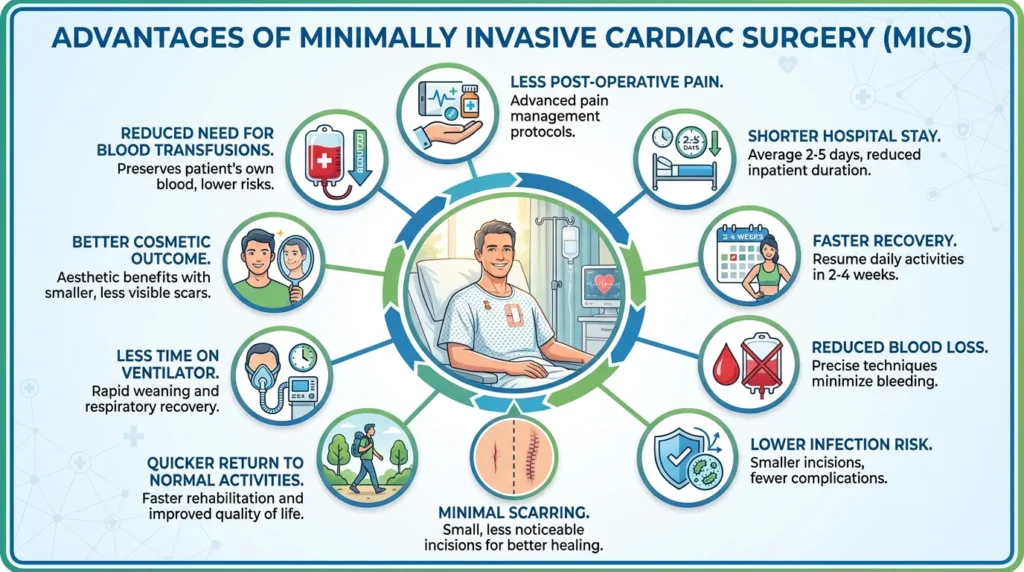
Because the breastbone is left intact, patients experience significantly less pain, lower blood loss, a reduced risk of wound infection, smaller and less visible scars, and a markedly faster return to everyday life. For the right patient, MICS delivers the same surgical result as conventional open-heart surgery with a far gentler recovery.
MICS vs Traditional Open-Heart Surgery
A clear side-by-side comparison (this table is a key advantage over competitor pages):
|
Sr.
|
Factor
|
Minimally Invasive (MICS)
|
Traditional Open-Heart
|
|---|---|---|---|
|
1
|
Incision
|
3–4 inch cut between the ribs
|
20–25 cm cut, breastbone divided
|
|
2
|
Breastbone
|
Left intact
|
Cut and wired back together
|
|
3
|
Blood loss
|
Lower
|
Higher
|
|
4
|
Infection risk
|
Lower
|
Slightly higher
|
|
5
|
Pain
|
Less
|
More
|
|
6
|
Hospital stay
|
3–5 days
|
5–7 days
|
|
7
|
Return to activity
|
2–4 weeks
|
6–8 weeks
|
|
8
|
Scar
|
Small, often hidden
|
Long, central chest scar
|
It is important to understand that MICS is not suitable for every patient or every condition. Dr. Parmar evaluates each case carefully — the safest, most effective approach is always chosen for the individual, never a technique for its own sake.
Heart Surgeries That Can Be Done Minimally Invasively
MICS-CABG / MIDCAB (Minimally Invasive Bypass)
Minimally Invasive Direct Coronary Artery Bypass (MIDCAB) allows selected single- or limited-vessel bypass surgery through a small left-chest incision without the heart-lung machine. Ideal for patients with disease in the front of the heart who want the fastest possible recovery.
Minimally Invasive Valve Repair & Replacement
Mitral and aortic valve repair or replacement can often be performed through a small right-chest incision. Valve repair, where possible, is preferred over replacement to preserve the patient’s own tissue. Dr. Parmar specialises in minimally invasive valve replacements for suitable candidates.
Minimally Invasive ASD Closure
Atrial septal defects (a hole between the heart’s upper chambers) can be closed through a small incision rather than open surgery in many patients — particularly relevant for younger patients who benefit most from minimal scarring and rapid recovery.
Benefits of Minimally Invasive Cardiac Surgery
- Smaller incision and minimal, often hidden scarring
- Less post-operative pain
- Lower risk of wound infection
- Lower risk of wound infection
- Shorter ICU and hospital stay
- Faster return to work and normal activities
- An excellent option for anxious patients and selected high-risk cases
Are You a Candidate for MICS?
Whether minimally invasive surgery is right for you depends on the type and location of your heart problem, your overall health, previous surgeries, and imaging findings. MICS is often suitable for:
- Selected single-vessel or limited coronary artery disease (MIDCAB)
- Many mitral and aortic valve conditions
- Atrial septal defects (ASD)
- Patients who are anxious about a full sternotomy
- Patients for whom a faster recovery is especially important

- It may not be suitable for complex multi-vessel disease, certain emergencies, or specific anatomical situations. Dr. Parmar will explain honestly whether MICS or conventional surgery offers you the safest outcome — your safety always comes first.
Your Treatment Journey: Step by Step

Recovery After Minimally Invasive Heart Surgery
Because the breastbone is not cut, recovery is noticeably quicker than after open-heart surgery. Most patients are walking within a day, leave hospital in 3–5 days, and return to light daily activities within 2–4 weeks. There are fewer restrictions on lifting and movement than with a sternotomy, although Dr. Parmar will give you a personalised recovery plan. Cardiac rehabilitation is recommended to optimise long-term heart health.
Know the Cost-
Cost of Minimally Invasive Cardiac Surgery in Ahmedabad
The cost of minimally invasive cardiac surgery in Ahmedabad varies by the specific procedure (bypass, valve or ASD), the complexity of the case, room category, length of stay and insurance coverage. While MICS may have a slightly different cost profile than open surgery, the shorter hospital stay and faster recovery often offset this. Most major insurance providers and corporate panels are accepted at HCG Hospitals, with cashless approval usually within 24–48 hours. A detailed estimate is provided after consultation.

Why Choose Dr. Abhishek Parmar for MICS?
Dr. Abhishek Parmar is trusted by thousands of patients for his calm guidance, clear communication, and genuine concern for their well-being. He blends advanced surgical expertise with a human touch, helping patients feel confident and cared for at every step of their heart-health journey.
- Specialist in minimally invasive valve replacements and ASD closures
- 20+ years of experience and 11,000+ cardiac, thoracic & vascular surgeries
- Early adopter of minimally invasive cardiac surgery (MICAS / MIDCAB) in Gujarat
- Honest, patient-first assessment — recommends MICS only when it is the safest option
- Atrial septal defect (ASD) closure
- HCG Hospitals’ advanced cardiac OT and dedicated CTVS ICU
- Full support for outstation and international patients
Frequently Asked Questions about CABG
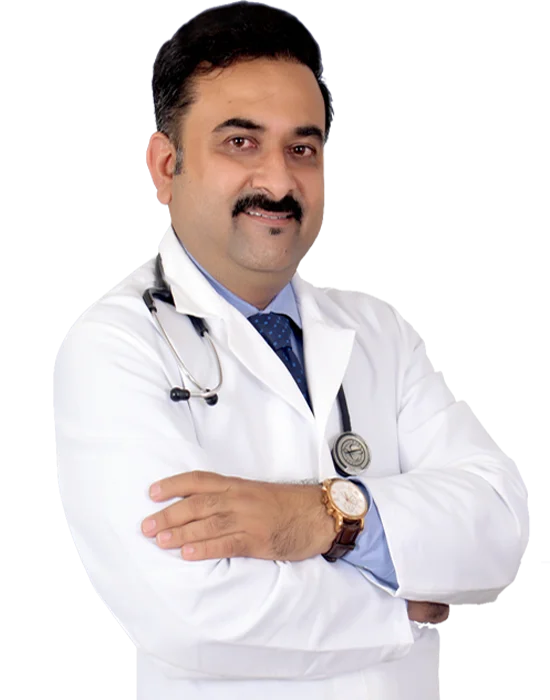
20+ years of experience
11,000+ successful cardiac, thoracic, and vascular surgeries
20+ years of experience
11,000+ successful cardiac, thoracic, and vascular surgeries
Q. Is minimally invasive heart surgery safe?
Yes — in experienced hands, MICS is as safe as conventional open-heart surgery, with the added benefits of smaller scars, less pain and faster recovery. Patient selection is the key to safety, which is why Dr. Parmar assesses each case individually.
Q. What is the difference between MICS and open-heart surgery?
In MICS, the surgeon operates through a small 3–4 inch incision between the ribs without cutting the breastbone. In open-heart surgery, the breastbone is divided for full access. MICS generally means less pain and a faster recovery, but it is not suitable for every condition.
Q. How long is the recovery after keyhole heart surgery?
Most patients walk within a day, leave hospital in 3–5 days, and return to light activity in 2–4 weeks — noticeably faster than the 6–8 weeks typical after open surgery.
Q. Can bypass surgery be done minimally invasively?
Yes, in selected patients. Minimally Invasive Direct CABG (MIDCAB) treats single- or limited-vessel disease through a small chest incision. Complex multi-vessel disease usually still needs conventional bypass.
Q. Will I have a large scar?
No. MICS leaves a small incision, often positioned so the scar is discreet and far less visible than the long central scar of open-heart surgery.
Q. Is minimally invasive surgery more expensive?
Costs vary by procedure. While the technique itself may differ in price, the shorter hospital stay and quicker recovery often balance the overall cost. A personalised estimate is provided at consultation.
Related Treatments
Heart Valve Surgery
Coronary Artery Bypass Surgery (CABG)
Total Arterial Bypass
Book Your Consultation
To find out whether minimally invasive cardiac surgery is right for you, book a consultation with Dr. Abhishek Parmar at HCG Hospitals, Ahmedabad. Outstation and international patients are welcome.